
Japanese shares gained slightly after President Donald Trump said negotiators made “big progress” in talks to strike a deal to avoid higher levies. The yen weakened after the country’s chief trade negotiator said currencies weren’t discussed. Gold advanced to a record while Treasury yields and a gauge of the dollar inched up.
The progress in discussions with Japan, “while preliminary, offer a small positive signal for markets,” said Rajeev De Mello, a global macro portfolio manager at Gama Asset Management. “Importantly, the trajectory of US-Japan trade talks will continue to be closely monitored, not just for their bilateral implications, but also as a potential framework for how the US may approach trade relationships with other allies.”
The moves come after a nascent calm across global markets was shattered by Federal Reserve chief Jerome Powell, who signaled a wait-and-see approach to Trump’s tariff offensive and pushed back on hopes he would act quickly to soothe investor fears. A two-day consolidation in stocks ended Wednesday after the US ratcheted up trade tensions by putting restrictions on some chip exports by Nvidia Corp. while China indicated it’s open for talks with the US.
Asked at the Economic Club of Chicago if he envisioned a “Fed put” in which the central bank intervened to calm markets, Powell said “no,” adding that too many questions exist about the impact of Trump’s policies. “We don’t know that yet, and until we know that we can’t make informed decisions.” For now, the US labor market is “in a really good place,” with supply and demand falling in tandem, Powell said.
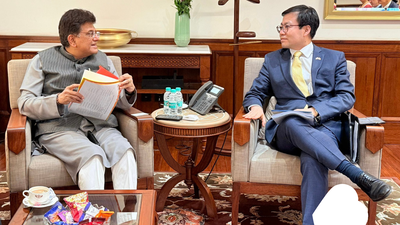
Japan and the US are aiming to hold a second round of tariff talks later this month, and hope to seal a deal as early as possible, said Ryosei Akazawa, who serves as Japan’s minister for economic revitalization.
China wants to see a number of steps from Trump’s administration before it will agree to trade talks, including showing more respect by reining in disparaging remarks by members of his cabinet, according to a person familiar with the Chinese government’s thinking.
“While we expect that trade talks will ultimately yield progress, the brinkmanship between the US and China looks set to continue in the near term,” said Solita Marcelli at UBS Global Wealth Management.
Cleveland Fed President Beth Hammack took a similar stance on Wednesday as Powell, suggesting the Fed should hold interest rates steady until there’s more clarity on the impact of levies. Swaps traders cemented bets on policy-easing, wagering the Fed would lower interest rates a full percentage point by next January.
“This has been a year of dashed hopes, first with disappointing tariffs, and now with the Fed leaving investors out in the cold,” said Michael Bailey, director of research at FBB Capital Partners. “Powell’s market snub came at a bad time with semis wreaking havoc on investor sentiment around the world.”
Data set for release in Asia on Thursday includes employment in Australia, an interest rate decision in South Korea, while foreign direct investment data for China may be released anytime through Friday. The Bank of Japan’s Junko Nakagawa will speak Thursday and the European Central Bank is set to hand down an interest rate decision.
In commodities, West Texas Intermediate, the US benchmark, climbed early Thursday in Asia after rising 1.9% Wednesday.
Also Read: Trade Setup for April 17: Nifty looks to sustain above 23,500 supported by FII buying