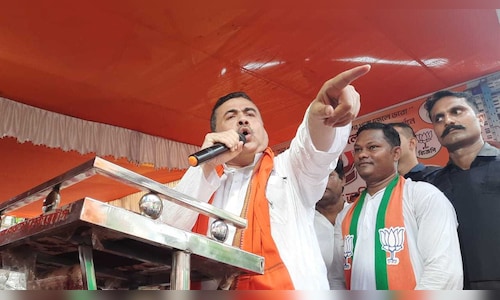

BJP Leader of Opposition, Suvendu Adhikari, is spearheading a targeted campaign with what he calls the “5% formula”, aimed at disrupting Chief Minister Mamata Banerjee’s political stronghold, as per News18 Hindi.
Caste enters in Bengal’s political strategy
Once considered socially inappropriate among Bengal’s elite ‘bhadralok’, the caste discourse has now become a central element in election strategy.
BJP has been intensifying its outreach to upper-caste communities – particularly Brahmins, Kayasthas, and Vaidyas – by farming framing them as ‘Sanatanis’ and appealing to their cultural and religious identities, as per The Hindu.
Read more: Mamata backs teachers and staff who lost jobs after SC verdict, says ‘ready to go to jail’
BJP leaders have also argued that the current state government, led by Mamata Banerjee, leans excessively in favour of minority communities at the cost of traditional Hindu values.
“Hindu Hindu Bhai Bhai” – BJP’s call for consolidation
The BJP has introduced the slogan “Hindu Hindu Bhai Bhai, 2026 BJP Chahi” as part of its larger plan to consolidate Hindu votes across the spectrum.
Suvendu Adhikari claims that a 5% swing in Hindu votes, from either previously neutral groups or those aligned with the Trinamool Congress (TMC), would be enough for the BJP to return to power in the next elections, reported News18 Hindi. This strategy includes outreach to both upper casts and marginalised Hindu communities like the Matuas.
On March 27, Adhikari led a padyatra to the Matua community’s headquarters in Thakurnagar and participated in their religious festivities.
During the visit, he portrayed the founders of the Matua community as defenders of the Hindu faith who shielded people from religious conversion.
Read more: Mamata Banerjee’s maiden speech at Oxford University marred with ‘go back’ slogans
Mamata’s caste declaration, a strategic response
The BJP’s caste-based mobilisation appears to have prompted a response from the chief minister herself. During an assembly debate on February 18, she stated, “I am not just a proud Hindu, I am a daughter of a Brahmin family.”
This marked the first time Banerjee publicly revealed her caste identity, reflecting the evolving nature of political discourse in the state.
Her comments came soon after five Dalits were escorted by police into a Shiva temple in East Bardhanam, a moment seen as symbolic of Bengal’s changing social landscape, reported News18.
Decline of Bengal’s ‘casteless’ political identity
For decades, West Bengal’s politics claimed to be above the caste system. Yest, the state’s power structures have largely remained in the hands of the upper castes despite the demographic makeup.
About 23.5% of the population is Scheduled Caste (SC), 16% Other Backward Caste (OBCs), 5.8% Scheduled Tribe (ST), with 27% minorities, as per The Hindu. Every chief minister and most cabinet ministers have historically come from the upper-caste bracket.
As historically marginalised groups like the Matuas, Rajbansis, and Kurmis begin to demand politic al representation, Bengal’s political terrain is undergoing a fundamental shift.
If Suvendu Adhikari’s 5% vote-shift formula succeeds, the BJP’s challenge to Benrejee may not be a distant 2026 , it could be already underway right now.
(With inputs from media reports)