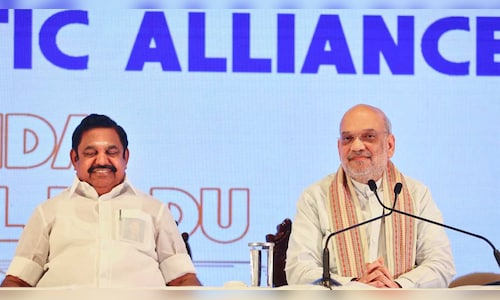

The party helmed by former Chief Minister Eddapadi K. Palaniswamy (EPS) remained in the saddle after a bitter fight with his party colleague and former Chief Minister O. Paneerselvam (OPS) for control over it. Having been associated with the BJP-led NDA government from 2016 to 2021, EPS enjoyed a working relationship with the BJP leadership. The announcement by Union Home Minister Amit Shah in Chennai last week also carried a clear political message of EPS leading the charge against the incumbent M K Stalin-led DMK alliance government.
The next summer elections are the last opportunity for EPS to prove to the electorate in Tamil Nadu that the alliance is the best and recapture the space lost after the death of former party supremo Jayalalithaa. Having drawn distance with the BJP barely two years ago following differences and voted against the Waqf (Amendment) Act this month, EPS will have to convince what led to the change of stance. Is it driven by the change of state leadership by the BJP by electing Nainar Nagenthran, in place of K Annamalai? Both EPS and Annamalai hail from the Gounder community and lay claim to a similar voter base.
The harder part would be to go around campaigning with the BJP which promised to draw up an agreed roadmap for governance popularly referred to as Common Minimum Programme. How does the AIADMK propose to tackle the impending delimitation exercise, the emotive issue of the three-language formula (read the charge of imposition of Hindi), or the NEET exemption, since it stands is comparable to the opposition by DMK?
Attacking the DMK-led government on issues of governance and corruption could be standard templates for the AIADMK yet EPS will have to work out an agreeable formula that would not place the alliance with the BJP, now inside the tent, at a disadvantage.
Statistics drawn from the 2021 assembly elections show that the DMK-led Secular Progressive Alliance, a 13-party coalition, secured 45 plus percent vote share with the DMK logging over 37% as against the incumbent AIADMK-led NDA recording nearly 40% vote share with the lead party securing slightly 32% vote share or a good five percentage points behind the DMK. However, the situation altered during the 2024 Lok Sabha polls.
The AIADMK snapped ties with the BJP and both parties contested leading separate coalitions. An aggressive campaign by the newly-minted Annamalai, resulted in the BJP vote share rising from some 2.60% in the 2021 assembly to slightly over 11%, in the Lok Sabha polls. The AIADMK got some 20% vote share as against 27% vote share by the DMK. These results show a mixed bag and both alliances will have to re-work the strategies to secure the maximum possible vote share.
On his part, CM Stalin charged the BJP-AIADMK alliance was a product of compulsion, accusing that the AIADMK was driven by action against its leaders by central agencies. While the DMK leader’s comment can be interpreted as a statement by a political opponent, ironically back in 1998 Jayalalithaa made Vajpayee, the then BJP-PM candidate wait for ‘letters of support’ suggesting hard political bargain for key portfolios.
However calculating what works best for either alliance now is one imponderable — the entry of a new party, Tamizhaga Vettri Kazhagam, founded by young superstar Vijay, aka ‘Thalapathy’ (Commander). Floated last year, the actor is working on his huge fan clubs, bringing them onto the party platform and attracting the youth and sections disenchanted with the largely rotating door governance offered during the last six decades by the two principal Dravidian parties.
Though Vijay has not made any announcement of his leaning he kept the door open for possible alliance. There is speculation that he could join hands with the AIADMK. Since the launch of TVK, the youthful star targeted the DMK accusing it of promoting dynastic rule.
Vijay’s entry once again connects Tamil politics to the Tamil cinema world, a link that began with C.N. Annadurai, M G Ramachandran, Karunanidhi, and Jayalalithaa and smaller roles by the late Vijayakanth and Kamal Hassan.
Anticipating the emerging political challenge, especially the youth-led movement, the DMK fast-forwarded the elevation of Stalin’s son Udhyaynidhi as the Deputy Chief Minister. Besides granting him time to consolidate, the move allows Chief Minister Stalin to craft a role for himself in national politics — as the coordinator of the Joint Action Platform on the delimitation issue, which is at the centre of discussion among parties in the south and elsewhere. Time to watch the political churn in Tamil Nadu.
—The author, K V Prasad, is an author and political analyst. The views expressed are personal.
Read his previous articles here